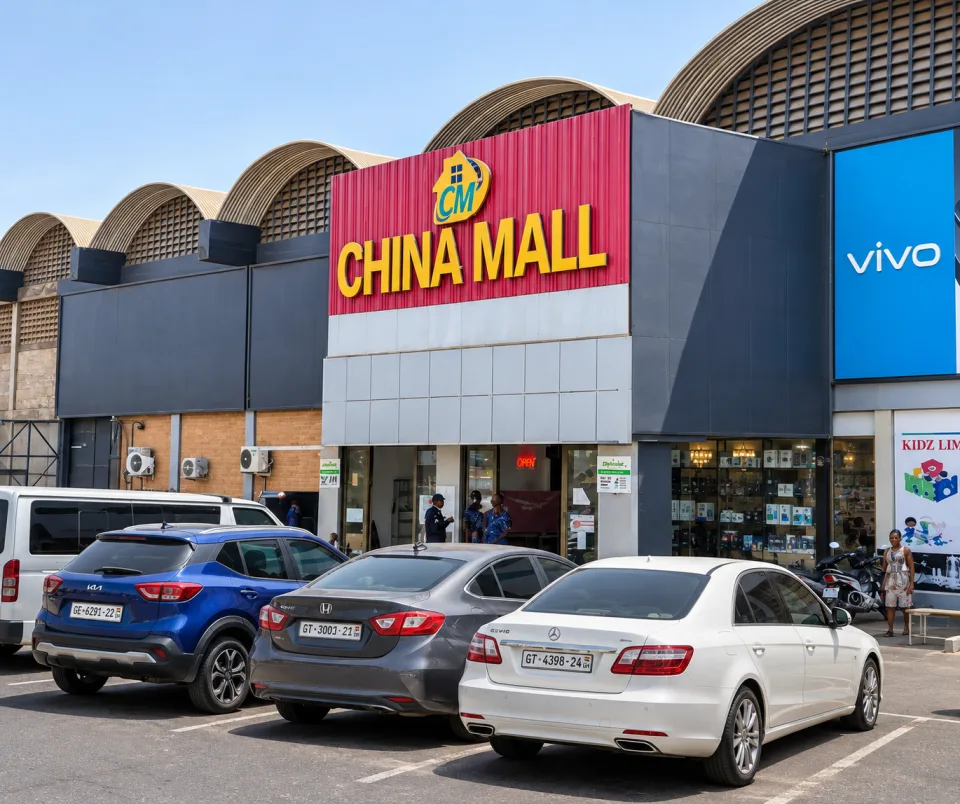


Chinese Malls Have Taken 60% of Our Market. GUTA President Raises Alarm Over Struggling Ghanaian Traders
The President of the Ghana Union of Traders' Associations (GUTA), Clement Boateng, has expressed serious concern over the rapid expansion of Chinese-owned shopping malls across Ghana, claiming that their growing presence is pushing local traders out of business.
According to Boateng, the malls have captured approximately 60% of the market share previously enjoyed by indigenous traders, leaving many Ghanaian businesses struggling to attract customers and generate sales.
Speaking on JoyNews' PM Express Business Edition on Thursday, November 5, 2026, the GUTA president questioned why authorities continued to permit the expansion of these shopping centres without adequately addressing their impact on local businesses.
His comments have renewed debate about foreign participation in Ghana's retail sector, competition and the protection of indigenous enterprises.
Chinese malls putting pressure on local traders
Boateng explained that Chinese-owned malls were becoming increasingly common, including in established commercial areas traditionally occupied by Ghanaian traders.
He argued that the development was creating significant challenges for small businesses, many of which depend on daily sales to cover operating expenses and support their families.
The GUTA president said the expansion of these outlets was one of the biggest concerns facing local traders, despite signs of improvement in Ghana's wider economic environment.
He questioned why Ghanaian-owned businesses were struggling to benefit from improving economic conditions while foreign-owned retail outlets continued to expand.
The 60% figure is GUTA's estimate, rather than an independently verified measurement of the entire Ghanaian retail market. No supporting national market-share study was identified in the reports reviewed.
Concerns over profits leaving Ghana
Beyond competition, Boateng raised concerns about the movement of profits generated by foreign-owned businesses.
He argued that successful Ghanaian-owned businesses are more likely to reinvest their earnings locally, while foreign investors may repatriate profits to their home countries.
The GUTA president believes the situation requires closer attention from government and the relevant regulatory authorities.
However, profit repatriation by a foreign investor is not, by itself, proof of illegal activity. Whether a business is operating lawfully depends on its registration, permitted activities and compliance with applicable Ghanaian laws.
What does Ghana's law say about foreign-owned shops?
Ghana's investment framework distinguishes between certain small-scale trading activities reserved for Ghanaians and larger retail investments that may be open to foreign participation when legal requirements are met.
In August 2026, Ghana Investment Promotion Authority chief executive Simon Madjie explained to GUTA that activities involving open markets, kiosks and small shops are reserved for Ghanaian citizens, while foreign investors may operate qualifying malls and supermarkets.
This distinction is important because not every Chinese-owned shopping mall is automatically operating illegally.
The central issue is whether businesses are complying with Ghana's investment and trading regulations and whether those regulations provide fair competition for local enterprises.
Ghanaian manufacturers also demand action
The concerns have received support from the Association of Ghana Industries (AGI), which is calling for stronger measures to protect locally manufactured products.
AGI Chief Executive Officer Seth Twum-Akwaboah has proposed a policy requiring foreign-owned shopping malls to allocate a specified percentage of their shelf space to Ghanaian-made goods.
He believes such a measure could create more opportunities for local manufacturers, reduce dependence on imported products and support employment.
The AGI has also called for greater support for domestic industries, including access to development financing and measures to address production costs.
The proposal has not been established as an existing legal requirement; it remains a policy recommendation.
Calls for government intervention
GUTA wants the government and relevant authorities to examine the operations of foreign-owned retail outlets and assess their effects on indigenous businesses.
The association's concerns also raise wider questions about access to affordable credit, the cost of importing goods and the ability of Ghanaian traders to compete with larger retailers.
At the same time, foreign-owned shopping malls can offer consumers wider product choices, competitive prices and employment opportunities.
The challenge for policymakers is to ensure that investment benefits the economy while businesses compete under the same applicable rules.
With Ghana's 2027 Budget scheduled for presentation on November 12, attention is turning to whether the government will introduce measures to support local traders and manufacturers.
For Boateng and GUTA, the immediate priority is ensuring that Ghanaian businesses are not gradually pushed out of the markets on which their livelihoods depend.